BEFORE WE CONTINUE
Focus this walkthrough
My résumé stays the source of truth. An AI layer can refocus the next overview for your context — selecting themes and evidence, not inventing a new story.
Preferred language
What are you looking for?
Choose one: General interest or Specific opportunity
Tell me what you want to explore.
Describe a particular role, company, or job opening.
Use only one field. Entering a specific opportunity automatically disables general-interest context, ensuring that the resulting résumé walk-through is tailored exclusively to the opportunity you described.

RÉSUMÉ · SYSTEMS ARCHITECT
Jeroen van Bemmel
Bridging the gap between innovation and operations by turning complex, emerging technologies into reliable, sustainable production systems
MASTER'S THESIS · 2000
Static scheduling for heterogeneous architectures
Hollandse Signaalapparaten (HSA, now Thales) · Hengelo · University of Twente
Master's work on statically compiling a real-time processing graph onto heterogeneous multi-processors under hard deadlines — for Goalkeeper, Signaal's CIWS target-analysis pipeline.
- Modeled the workload as a directed operator graph with costs and precedence
- Scheduled operators onto boards/processors and generated inter-processor communication glue
- Targeted hex TI TMS320C54 DSP boards; explored a memory-bar Mercury platform as a replacement


Why it still matters
Not just placement: a hardware-agnostic operator graph became a distributed implementation with explicit communication. Graph transformation, placement, communication cost, and execution constraints remain central to heterogeneous ML compilation.
References
BELL LABS INNOVATIONS · 2001–2006
Where control-plane engineering started
Research & Development Engineer · Lucent Technologies / Bell Labs
Designed and implemented carrier-grade signaling systems, focusing on the gap between protocol models and real-world concurrent execution.
- Built HPJSS, a high-performance Java SIP stack for carrier service platforms which enabled the Lucent Service Broker product to meet its performance KPIs for commercial launch
- Researched multiprocessor scheduling, distributed signaling, and protocol-oriented infrastructure
- Contributed to European research projects and conference publications
- Engineered control and data-plane systems where correctness, scalability, and concurrency were critical

Intellectual Property
33 U.S. patents
Inventor across signaling, networking, and distributed systems. SIP message prioritization from this Bell Labs work is one of them — US 2007/0253412.
SYSTEMS PROGRAMMING · C++
HPjSS++: carrier-grade SIP from the socket up
High-performance C++ signaling stack · Alcatel-Lucent / Bell Labs Europe · 2006–2007
A production-oriented implementation of RFC 3261, engineered for predictable resource use and high signaling throughput.
- ~51,700 lines · 235 C/C++ files across public APIs, parser, transactions, dialogs, transports, utilities, applications, and tests
- Buffer-oriented parsing with lightweight string views, lazy typed headers, and receive-context ownership to limit copying
- Traffic-profile-driven preallocation of receive contexts, transactions, timers, and related objects for stable memory behavior under load
- Concurrent protocol machinery: atomic state transitions, timer queues, retransmission, cancellation, and timeout handling
Production-grade depth
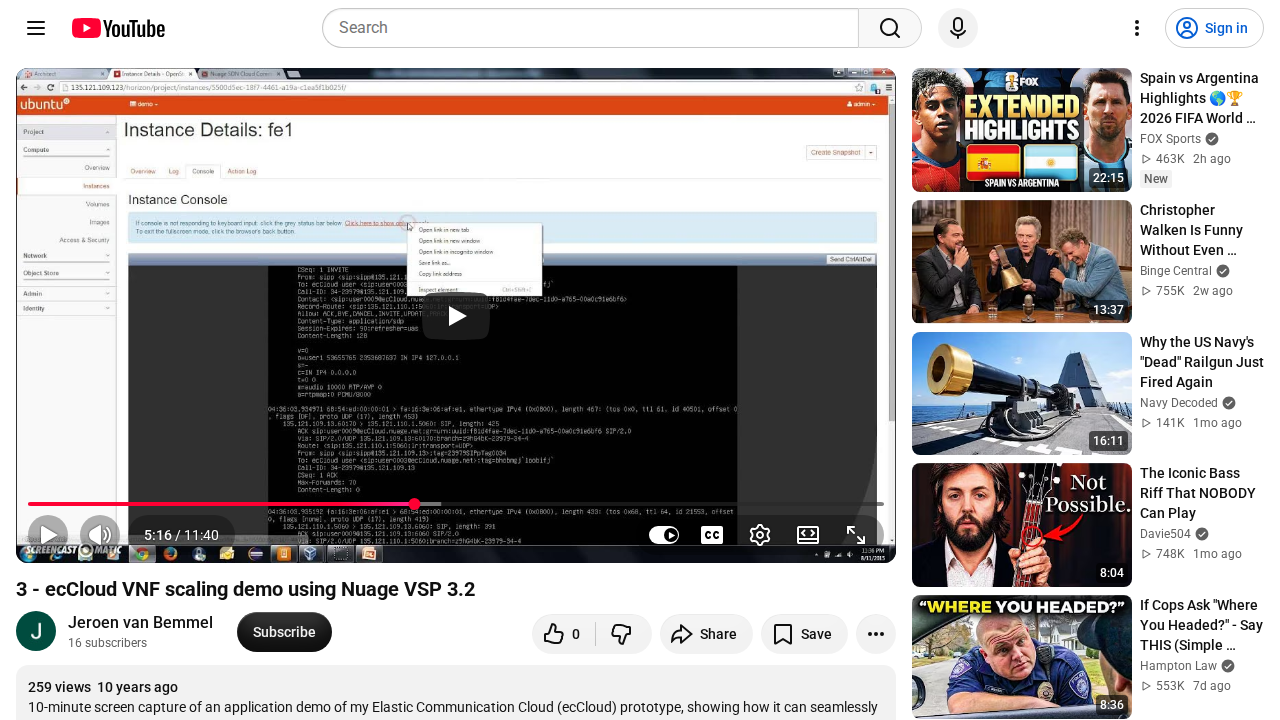
HPjSS++ in action · ecCloud VNF scaling demo · opens at 5:16
Engineering concerns made explicit
- Bounded allocation on critical paths
- Explicit ownership and object lifetimes
- Threading, locks, atomics, and timers
- Debug and optimized static-library builds
- Runnable endpoint and proxy applications
OPERATING SYSTEM ENGINEERING · 2002–2012
MyOS: architecture all the way down
Experimental freestanding 32-bit x86 operating system · C++ and assembly
A decade-long personal systems project exploring how explicit interfaces and component models can organize an operating system from boot to network services.
Implemented the execution path from boot sector through paging, interrupts, timers, threads, SMP, device drivers, filesystems, and TCP/IP networking.
Modeled versioned components and interfaces in XML, using XSLT to generate composition and initialization code.
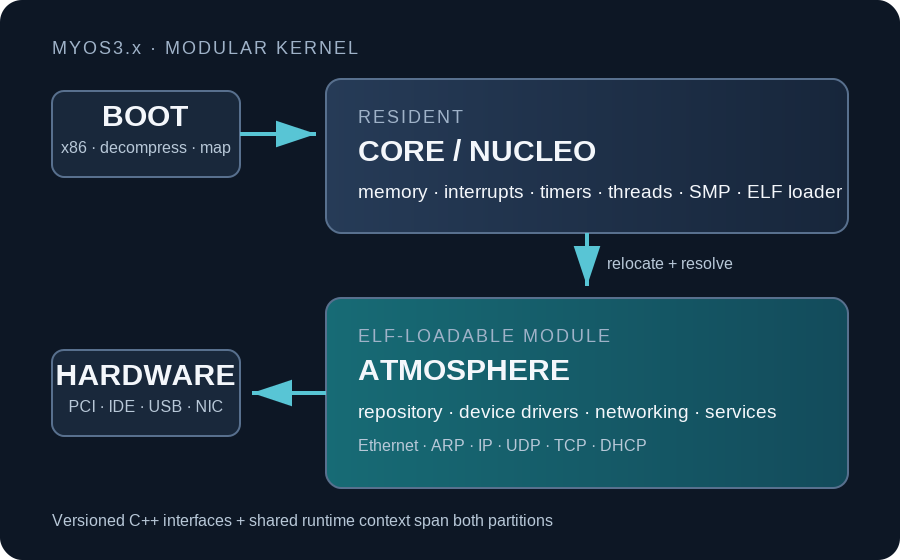
Evolved the architecture from a statically linked kernel into a resident Core plus a dynamically loaded ELF Atmosphere module, with components discovering one another through a shared runtime context rather than hidden dependencies.
Depth across the stack
MyOS3.x · ~47,500 lines · 356 source files
boot + protected mode + paging
interrupts + APIC + timers
threads + processes + SMP
PCI + IDE + USB + network drivers
FAT + ISO9660
Ethernet + ARP + IP + UDP + TCP + DHCP
The architectural shift moved higher-level facilities out of the resident kernel while preserving the same component contracts across the binary boundary.
ALCATEL-LUCENT · 2007–2012
From Research to Customer Impact
Customer-facing architecture and business development · Alcatel-Lucent
Spent six years bridging engineering, product strategy, and customer delivery—translating emerging technology into commercially successful solutions.
- 2007–2009 · Business Development Manager — KPN strategic account team, positioning IMS, femtocell, and application solutions with technical and commercial stakeholders.
- 2009–2010 · Multimedia Solution Architect — Digital Home & Applications, defining solution requirements and building prototypes for Home Media Sharing engagements.
- 2011–2012 · Business Development Manager — Multimedia — Responsible for the Benelux and Nordics multimedia portfolio, including the Multiscreen Video Platform and Velocix CDN, working with customers such as KPN, Liberty Global/UPC, Ziggo, and TDC/YouSee.

Won the competitive evaluation against Ericsson RedBand by positioning Alcatel 7250 routers using SSRP for critical service reliability — a first-time IP-domain entry at KPN.
SOFTWARE-DEFINED NETWORKING · 2012–2019
Bringing SDN into Customer Networks
Nuage Networks (Alcatel-Lucent / Nokia)
Helped customers adopt software-defined networking by turning a new platform into production-ready deployments across service providers, cloud providers, and large enterprises.
Calgary → New Orleans → Houston
- Led customer engagements from technical discovery and solution planning through deployment and operational validation
- Designed and executed production-scale proof-of-concepts that demonstrated real business and operational value
- Standardized deployment workflows across OpenStack, VMware, KVM, and public cloud environments, making evaluations faster and more repeatable
- Developed Nuage Simplify, an automation framework for customer deployments, while driving issue analysis and engineering escalation in complex production environments


MODEL-DRIVEN INFRASTRUCTURE · 2019
Turning architecture intent into repeatable deployment
Nuage Simplify · model-driven deployment framework
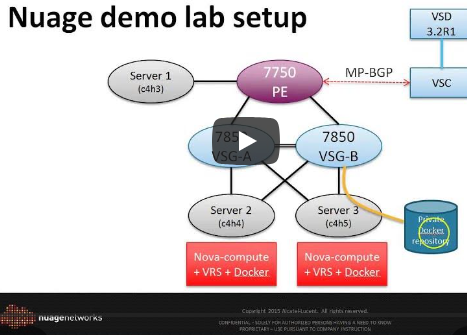
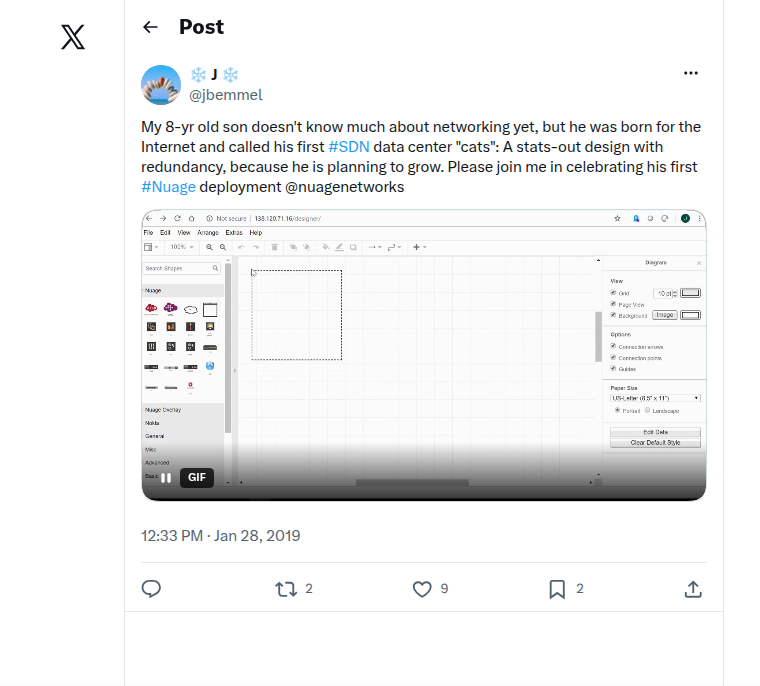
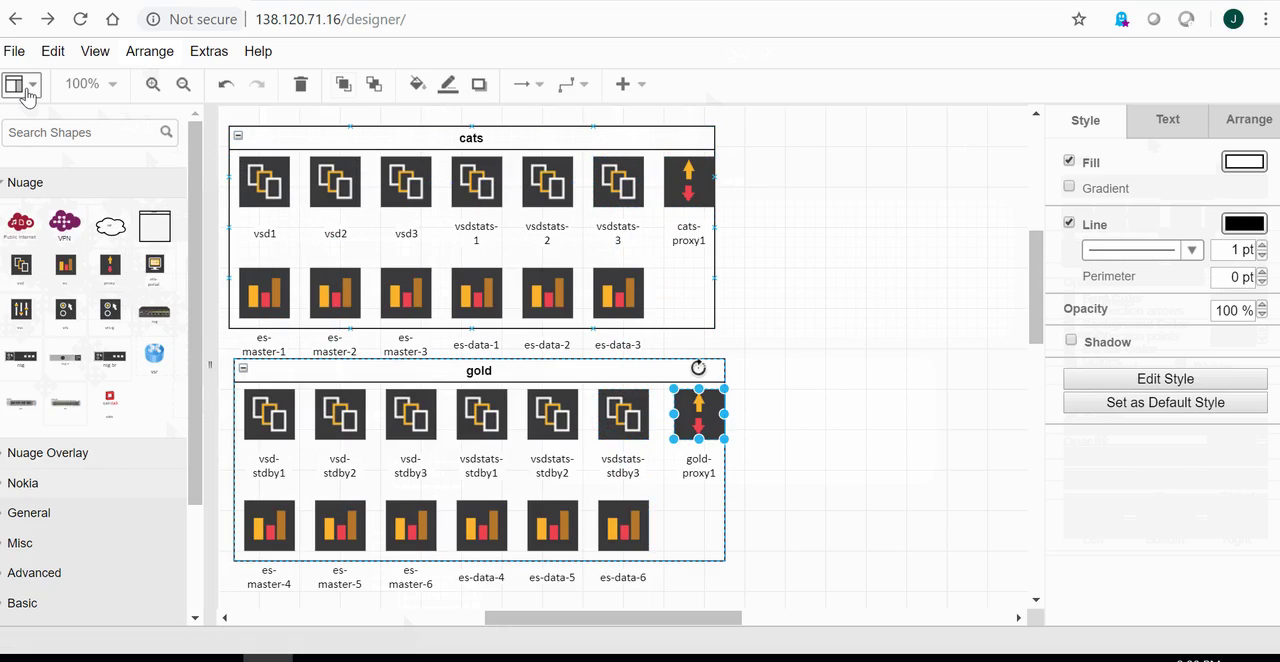
I created a visual infrastructure modeling system in which architecture designs became executable specifications. The model supplied deployment parameters to Ansible playbooks I authored for OpenStack, VMware, AWS, Azure, and GCP.
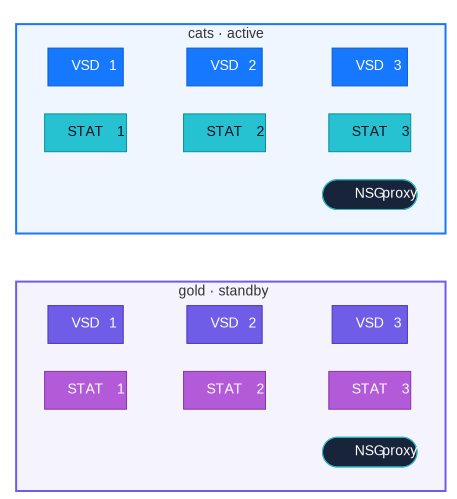
- Systems architecture — captured multi-site topology, roles, redundancy, and environment-specific intent in a semantic model
- Automation engineering — translated that model into deterministic parameters for reusable deployment workflows
- Product thinking — made production-grade complexity approachable enough for an eight-year-old to prepare a complete redundant trial in 1:11
MODERN ROUTING PLATFORM · 2019–2024
Modernizing Data Center Networks
Cloud Majors Software Automation Architect · Nokia
Worked with strategic enterprise and cloud customers to modernize data center networking through SR Linux, EVPN fabrics, and automation — bridging legacy infrastructure with next-generation operational models.
- Served as the primary technical advisor for strategic cloud engagements, leading architecture reviews, executive workshops, and end-to-end solution validation
- Led EVPN migration programs, translating complex multi-vendor environments into practical deployment strategies and production-ready proof-of-concepts
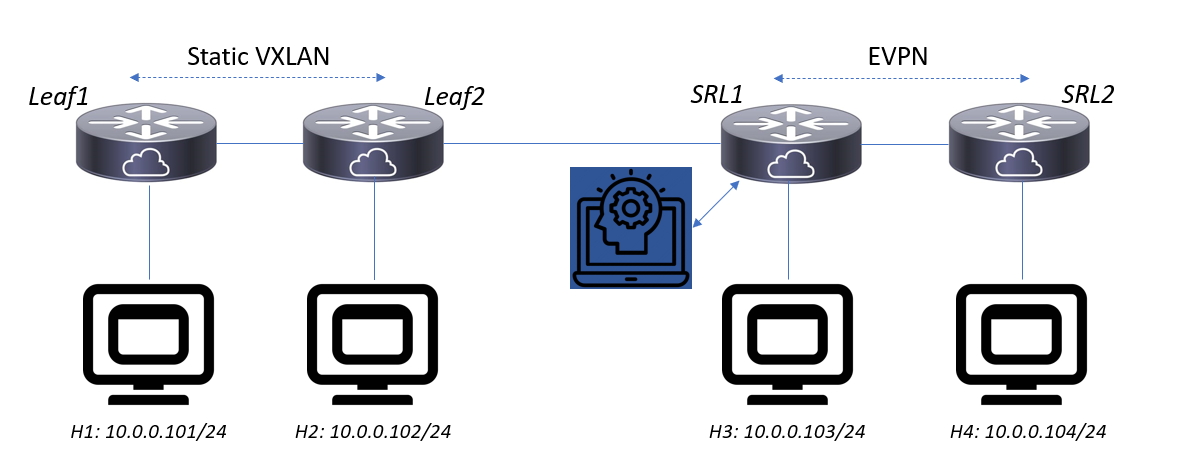
- Designed and productized the SR Linux EVPN Proxy, enabling incremental migration from static VXLAN to dynamic BGP EVPN without disruptive cutovers
- Developed schema-driven orchestration and validation approaches that maintained correctness across distributed network platforms

 Solving the Migration Challenge
One of the biggest barriers to EVPN adoption was the need for a disruptive “big bang” migration.
Developed the SR Linux EVPN Proxy to bridge static VXLAN and dynamic EVPN fabrics, enabling customers to modernize incrementally while maintaining operational continuity.
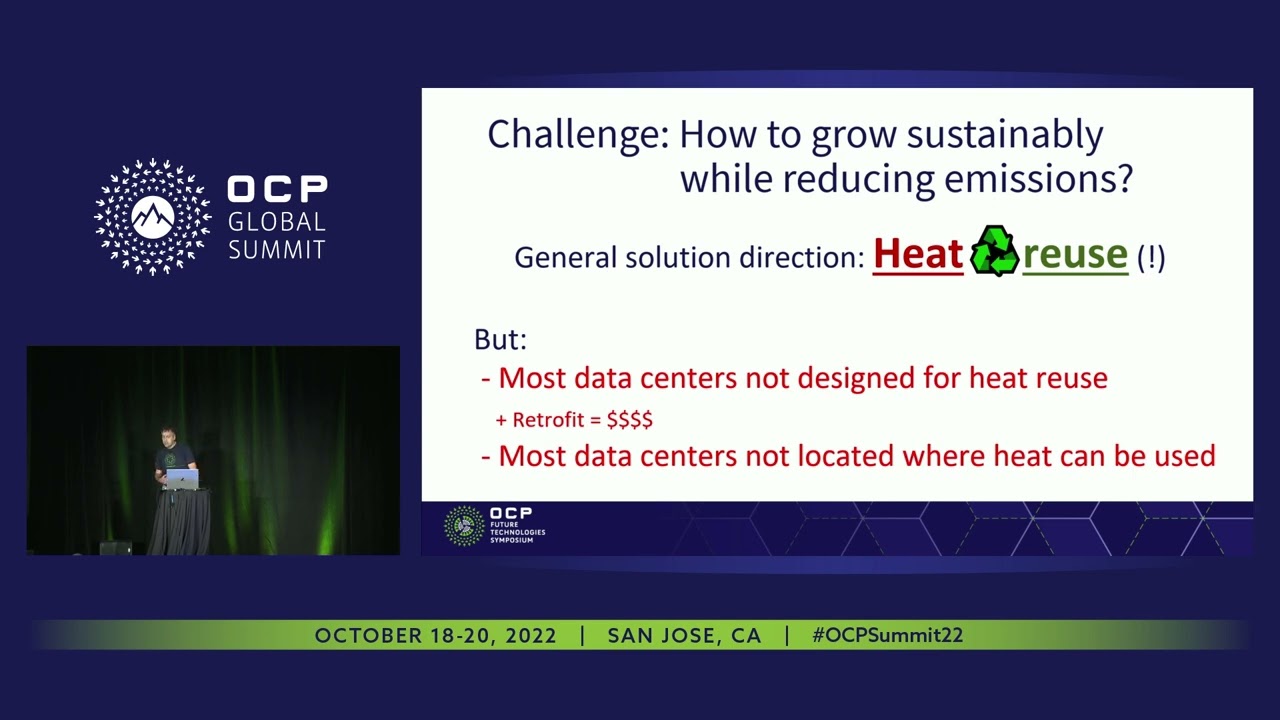
OPEN COMPUTE HEAT APPLIANCES
Sustainable decentralized compute
OCP Future Technologies Symposium · San Jose · October 2022
Presented for Exergy ∞ LLC
Repurpose retired data-center CPUs and GPUs as connected heat appliances — reuse compute heat for buildings, and return distributed capacity to a sustainable cloud.
The model
Refurbished compute → Heat reuse → Coordinated charging → Decentralized cloud
- Extend hardware life past the 3–4 year refresh cycle in heat pumps and thermal storage
- Coordinate charging over the network to help balance renewable supply
- Drive open standards through OCP so the ecosystem can scale

RETHINKING SUSTAINABLE VALUE CREATION
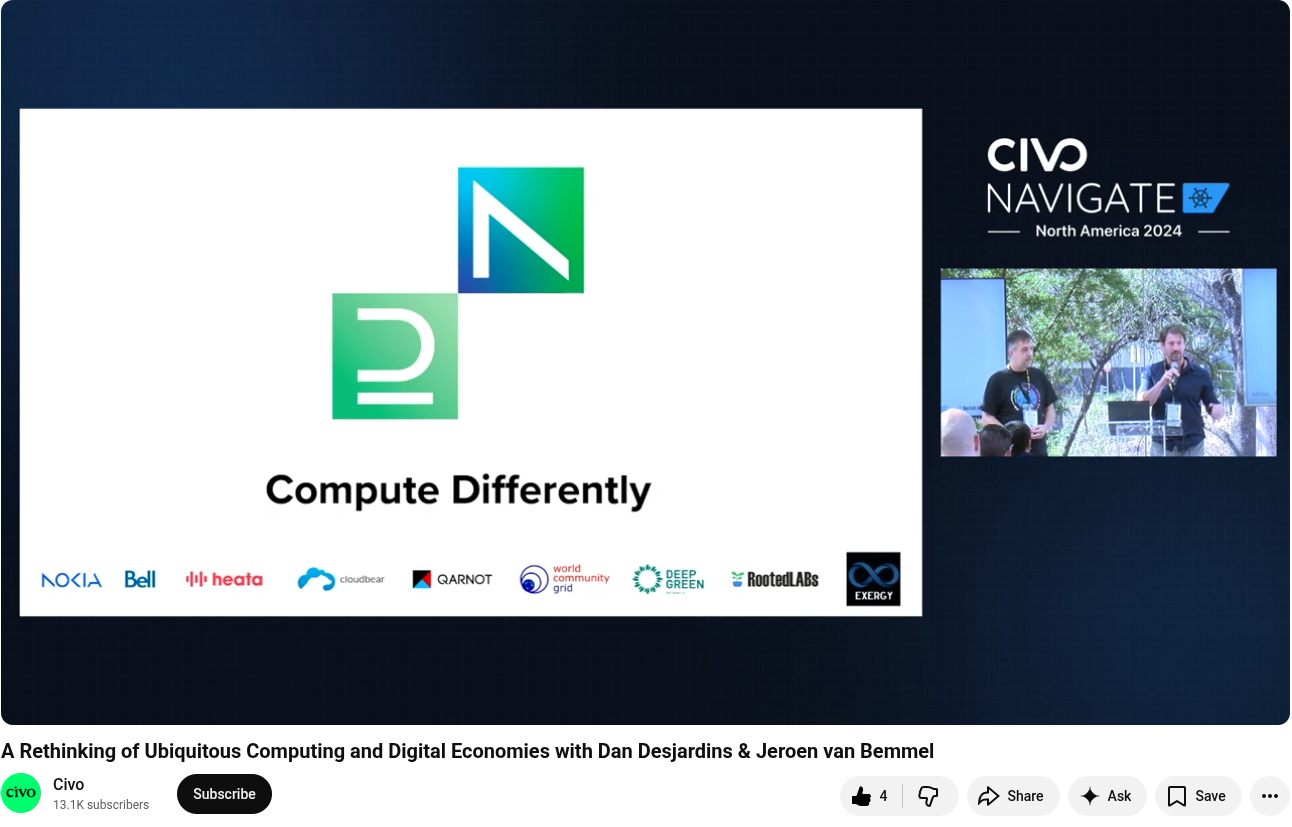
Compute Differently
Civo Navigate · Austin · February 2024 · Co-presented with Dan Desjardins · Distributive
Rethinking how computing capacity is created, shared, and valued.
We explored an alternative to concentrating ever more computing capacity in hyperscale infrastructure: putting idle CPUs and GPUs already present in phones, enterprises, and telecommunications infrastructure to productive use.
The model — Existing capacity → Measured work → Distributed contribution → Shared value
Demonstrated live
- Created an ad-hoc compute cloud from devices in the audience
- Extended the model to a larger astrophysics workload across partner compute groups
- Connected distributed compute with networking, sustainable infrastructure, and research

ENERGY INFRASTRUCTURE · 2024–2026
Governing Change in Production Infrastructure
Senior Infrastructure & Automation Engineer · EOG Resources
Designed data center infrastructure and automation workflows for a high-change operational environment, applying model-driven approaches to improve reliability, validation, and control.
- Designed Ethernet data center fabrics for Mellanox leaf switch deployments as EOG modernized its production infrastructure
- Helped EOG move from a centralized Layer-2 VLAN infrastructure to a fully routed design for Dell core switches across data centers
- Built virtual validation workflows using NetBrain and Netlab to test provisioning changes before production deployment
- Introduced AI-assisted inventory and change-control workflows with human validation and operational auditability
- Shifted infrastructure operations from CLI-driven configuration toward model-driven, policy-constrained execution

Selected outcomes
Fabric modernization — Defined topology and operational standards for new Ethernet data center fabrics. Evidence · Mellanox leaf deployments
Routed core migration — Helped EOG move from a centralized L2 VLAN infrastructure to a fully routed design for Dell core switches across data centers. Evidence · Dell core · multi-DC
Validated change — Enabled pre-production testing of network changes against virtualized environments before deployment. Evidence · NetBrain · Netlab
TOWARDS MODEL-DRIVEN SYSTEMS · 2026
xFrame · Exergy ∞ LLC
Applied the same model-driven principles used in infrastructure engineering to AI-enabled computational systems and knowledge workflows.
xFrame explores how declarative models become the foundation for reliable, reproducible computation — defining complex information structures once and compiling them through intermediate representations into multiple execution and presentation targets.
- Define complex information structures once in a declarative model and compile through intermediate representations into multiple execution and presentation targets
- Make provenance and reproducibility first-class so computational outputs can be reviewed, regenerated, validated, and evolved as underlying models change
- Apply schemas, templates, and explicit transformation stages to constrain AI-assisted workflows and preserve correctness
- Extend model-driven engineering principles from infrastructure automation into AI-enabled computational systems

Practical YANG subset for runtime semantic validation, cross-references, and structural rules — foundational to model-driven correctness. Evolved further in Mojo as comptime types.
github.com/exergy-connect/xYangPublished agent skills and tooling for model authoring, consolidation, and presentation workflows around the xFrame specification.
github.com/exergy-connect/xFrame.aiCOMPILER / LANGUAGE SYSTEMS · MOJO · 2026
xYang.mojo · YANG as a comptime type primitive
Open source · Mojo realization of xYang · Exergy ∞ LLC
A Mojo-native realization of my Python/JavaScript xYang project, redesigned around Mojo's comptime type system rather than implemented as a direct language port.
The experiment explores whether YANG semantics can become part of the compile-time type system, turning a schema language into an executable semantic layer for arbitrary object models.
- Encode YANG semantics — ranges, conditional presence, cross-field invariants, leafrefs, list keys — as parametric Mojo types
- Resolve constraints during compilation through
comptimerather than relying solely on runtime validation - Treat YANG as a semantic IR: Mojo types become executable representations; JSON Schema and OpenAPI become projections
- Explore the boundary between compile-time semantic validation and runtime model behavior
The constraint is the type
comptime Age = YangLeaf[
    YangBuiltinUInt8,
    YangConstraints[
        Range=YangRange[18, 120]
    ]
]
YANG AST, XPath for must/when, runtime validator, and comptime reflection checks against modeled Mojo structs.
github.com/exergy-connect/xYang.mojoOpen proposal to make xYang an installable Mojo library with a reproducible demo — testing whether semantic contracts as comptime types resonate with Mojo developers.